Ancient History
Introduction to Ancient Egypt
Discover the land of pharaohs, explore the Nile's role, and understand the foundations of one of history's greatest civilizations.
The Gift of the Nile
Ancient Egypt could not have existed without the Nile River. Every year, between June and September, the Nile flooded its banks and deposited a rich layer of black silt across the surrounding farmland. Egyptians called this fertile strip the "Black Land" (Kemet) and the surrounding desert the "Red Land" (Deshret). This annual flooding created some of the most productive agricultural land in the ancient world, allowing Egypt to support a large and complex civilization for over three thousand years.
The Nile also served as Egypt's highway. The current flows north toward the Mediterranean Sea, while the prevailing wind blows south. This natural dynamic meant that boats could sail upriver (south) by raising their sails and drift downriver (north) with the current, making trade and communication across Egypt's 700-mile length remarkably efficient.
Egypt was divided into Upper Egypt (the narrow river valley in the south) and Lower Egypt (the broad delta in the north). Around 3100 BCE, a pharaoh — traditionally named Narmer or Menes — unified these two kingdoms, creating one of history's first nation-states. The double crown of Egypt, combining the white crown of Upper Egypt and the red crown of Lower Egypt, symbolized this unification for millennia.
Pharaohs, Gods, and the Divine Order
The pharaoh stood at the center of Egyptian society — not merely as a political leader but as a living god, the earthly embodiment of Horus and, after death, Osiris. This divine kingship was fundamental to Egyptian ideology. The pharaoh was responsible for maintaining Ma'at: the cosmic principle of truth, justice, and order that kept the universe from descending into chaos.
Egyptian religion was polytheistic, featuring hundreds of deities. The most important included Ra (the sun god), Osiris (god of the afterlife and resurrection), Isis (goddess of magic and motherhood), Horus (sky god and divine kingship), Anubis (god of mummification), and Thoth (god of wisdom and writing). These deities were often depicted with human bodies and animal heads — Anubis with a jackal's head, Thoth with an ibis, Horus with a falcon.
The afterlife was central to Egyptian belief. Egyptians believed that if the correct rituals were performed and the heart of the deceased was judged worthy, the soul could live eternally in the Field of Reeds — a paradise mirroring Egypt itself. This belief drove the enormous investment in tombs, mummification, and funerary texts like the Book of the Dead, which served as a guide for navigating the afterlife.
Monuments, Writing, and Legacy
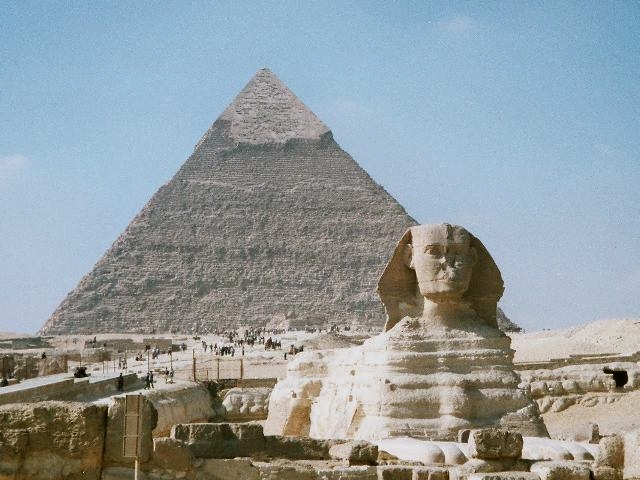
The Great Pyramid of Giza, built around 2560 BCE for Pharaoh Khufu, remains one of the most extraordinary engineering achievements in human history. Standing originally at 481 feet, it was the tallest man-made structure on Earth for over 3,800 years. The pyramids were not built by slaves, as popular myth suggests, but by organized teams of skilled workers who received food, medical care, and burial honors.
Egyptian hieroglyphics — one of humanity's earliest writing systems — were developed around 3200 BCE. This system used over 700 symbols representing sounds, words, and concepts. For centuries after Egypt's decline, hieroglyphics were unreadable until 1822, when French scholar Jean-François Champollion deciphered the Rosetta Stone — a decree written in hieroglyphics, Demotic script, and ancient Greek.
Egypt's legacy stretches from mathematics (they could calculate the area of a circle and the volume of a pyramid) to medicine (the Edwin Smith Papyrus contains the earliest known description of the human brain) to architecture. Greek philosophers including Plato and Pythagoras reportedly studied in Egypt, and Egyptian concepts of monotheism may have influenced Abrahamic religions. Even our 365-day solar calendar derives from the ancient Egyptian calendar.
Key Facts
- Duration:
- 3100–30 BCE (over 3,000 years)
- Capital:
- Memphis, then Thebes, then Alexandria
- Writing system:
- Hieroglyphics (~3200 BCE)
- Largest pyramid:
- Great Pyramid of Khufu, ~2560 BCE
- Final ruler:
- Cleopatra VII, died 30 BCE
“My name is Ozymandias, King of Kings; Look on my Works, ye Mighty, and despair! Nothing beside remains.
— Percy Shelley's sonnet, inspired by the fallen statue of Ramesses II, 1818