Medieval History
Magna Carta & the Rule of Law
How a 1215 charter in England laid groundwork for constitutional government and limits on royal power.
King John and the Barons
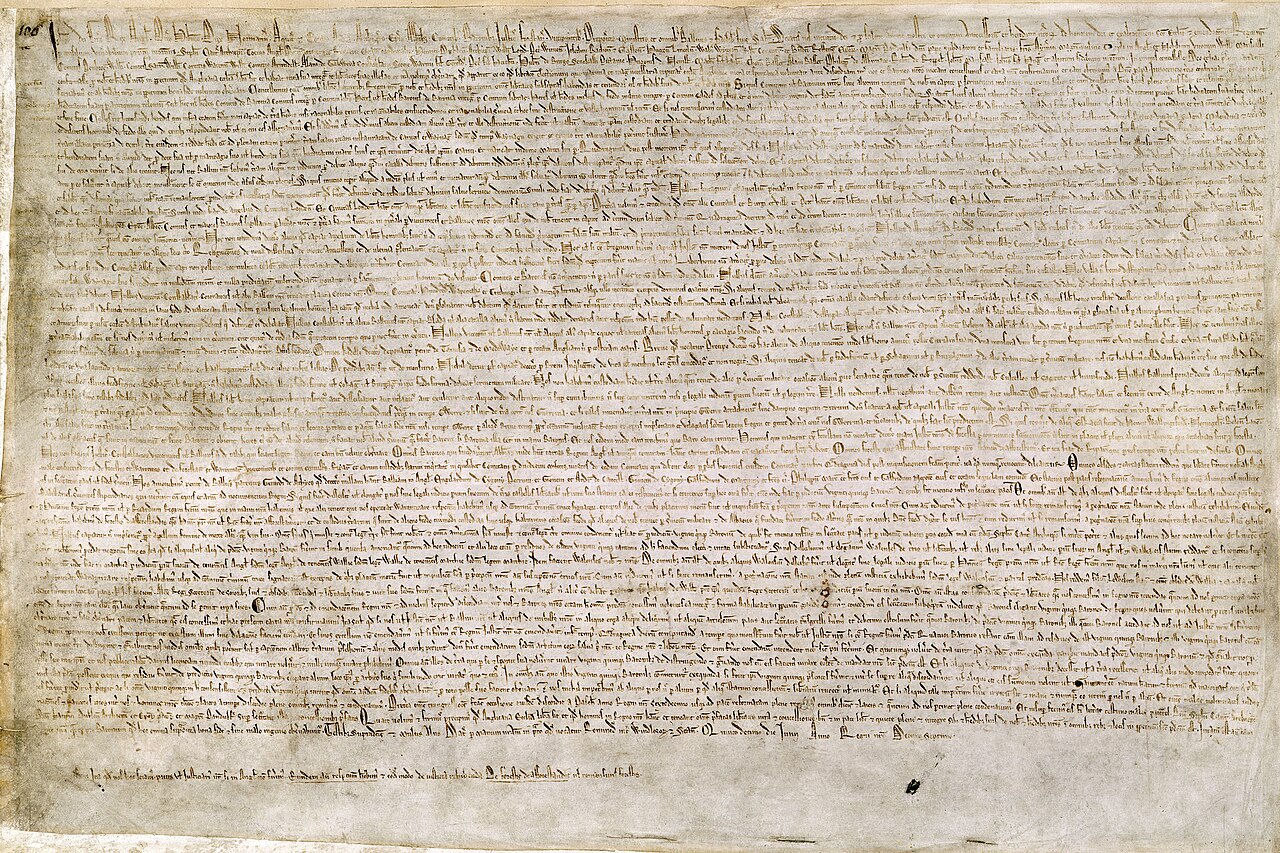
In 1215, King John of England faced a rebellion from his own barons, frustrated by his heavy taxation, arbitrary imprisonments, and failed military campaigns in France. Meeting at Runnymede meadow on the Thames in June 1215, John was forced to affix his seal to Magna Carta — the Great Charter — a document that placed specific limitations on royal power for the first time in English history. Though John immediately sought papal annulment of the charter (which was granted), it was reissued by subsequent kings and became a foundational constitutional document.
Key Principles of Magna Carta
Magna Carta's 63 clauses dealt mainly with practical feudal grievances, but three principles proved historically transformative. Clause 39 stated that no free man could be imprisoned, dispossessed, or destroyed except 'by the lawful judgment of his peers or by the law of the land' — the origin of due process and the right to trial by jury. Clause 40 declared 'To no one will we sell, to no one will we refuse or delay, right or justice.' And Clause 61 established a council of 25 barons with the right to compel the king to observe the charter — an early concept of constitutional accountability.
Legacy: From Medieval England to Modern Democracy
Magna Carta's immediate impact was limited — it applied only to free men (perhaps 10% of England's population) and was frequently violated. But its symbolic and legal importance grew enormously over centuries. In the 17th century, lawyers like Edward Coke invoked Magna Carta against the Stuart kings to argue for parliamentary supremacy. English colonists in America cited Magna Carta as authority for their rights; the Fifth and Fourteenth Amendments to the US Constitution echo its language. The Universal Declaration of Human Rights (1948) builds on the same tradition. Magna Carta established the principle that even the most powerful ruler is subject to law.
Key Facts
- Signed:
- June 15, 1215, Runnymede, England
- Key clause:
- Clause 39 — due process; no imprisonment without lawful judgment
- Who benefited:
- Initially only free men (~10% of population)
- Later influence:
- US Constitution, Bill of Rights, Universal Declaration of Human Rights
“No free man shall be seized, imprisoned, dispossessed, outlawed, exiled or in any way ruined... except by the lawful judgement of his peers or by the law of the land.
— Magna Carta, Clause 39, 1215